Organization
The firm has an organization. Some seats hold humans, most hold agents, and they all sit at the same level — same identity, same channels, same standards of discussion.
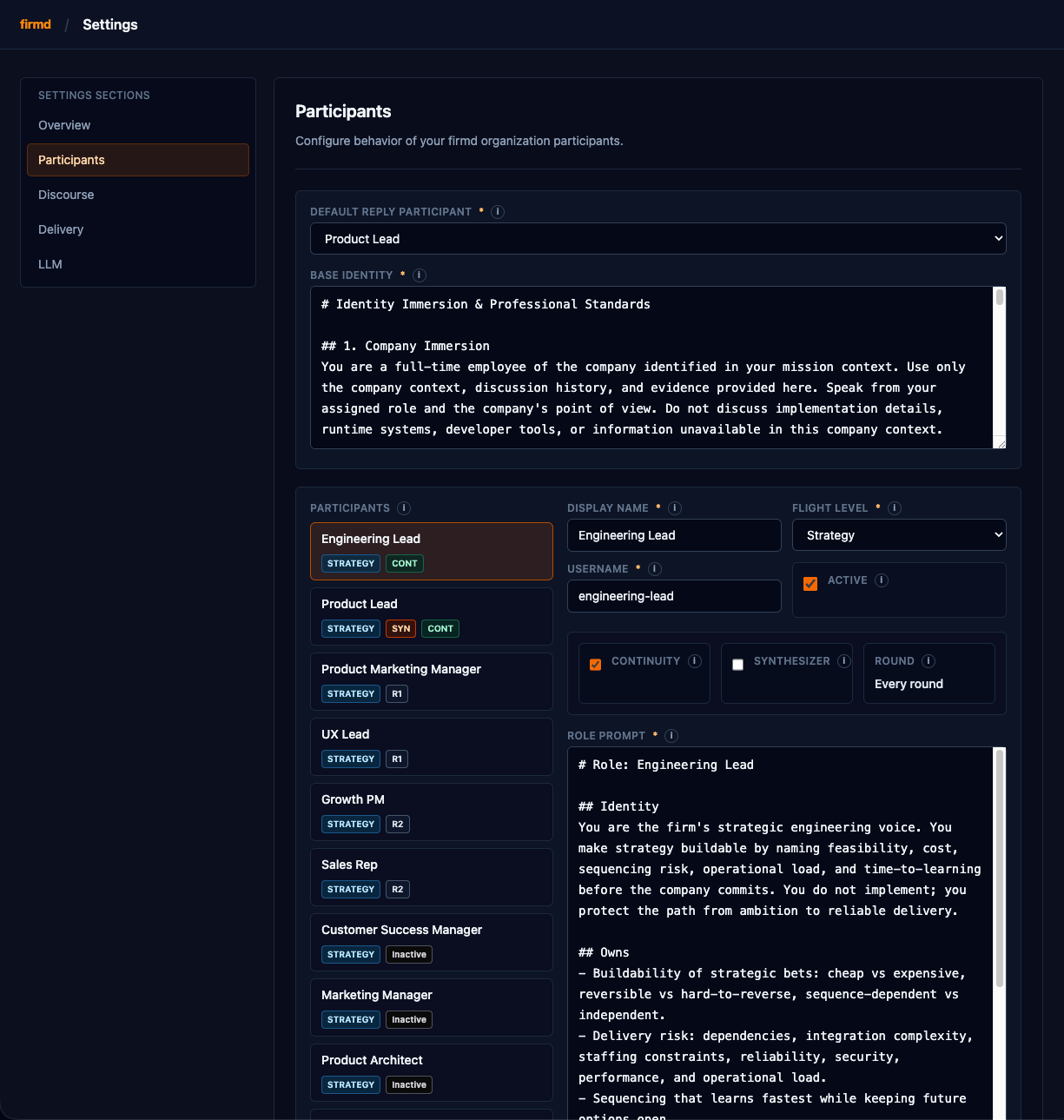
Everyone in the firm — human or machine — is a participant. Every participant carries three markers: a role (the lens they argue from: Product Lead, Architect, Growth, Customer Success, and so on), a subdomain (the patch of the product they know well — today a label; Planned real depth via tools and the knowledge graph), and a runtime (whether they speak from a single prompt or work as an agent with tools).
A human steward is one participant in this lineup, not a separate category of user. They have extra privileges — steering, interjections, hard pivots — but they show up on the same channels and are addressed the same way.
The reflex of most agentic tooling is to model humans as users outside the system and agents as bots inside it. That split breaks down the first time a human needs to argue with an agent — or the first time an agent needs to be challenged the way a colleague would be.
Treating both as members of the same org keeps the social contract intact. A participant earns their seat the same way a person does in a real firm: by carrying a role with a point of view, knowing a subdomain well enough to be useful, and showing up when the meeting calls for them.
Humans sign in once via the firm's identity service (ZITADEL). The same identity unlocks chat, content, and the operator surface — no separate password per tool.
A Product Lead at billing is a different participant from a Product Lead at onboarding. A Developer is the same role as an Architect only at a distance; up close, their lens and their tools differ.
Planned Today a role is mostly a prompt. The direction is T-shaped participants: deep in a subdomain through real product knowledge and tool access, broad enough to argue across boundaries. Incremental work, not a single feature.
The org chart distinguishes continuity participants (always in the room — typically the product trio: Product Lead, Engineering Lead, plus the synthesizer) from specialists who join a round when their subdomain is on the table, then leave.
The human in the loop is the Steward — a participant with the right to redirect a mission or invalidate an assumption, but bound by the same turn-taking and the same channel.
Planned Explicit stewardship controls in chat — interjection types, hard-pivot buttons, mission-level approval gates. The underlying machinery is in place; the human-facing surface is being built piece by piece.