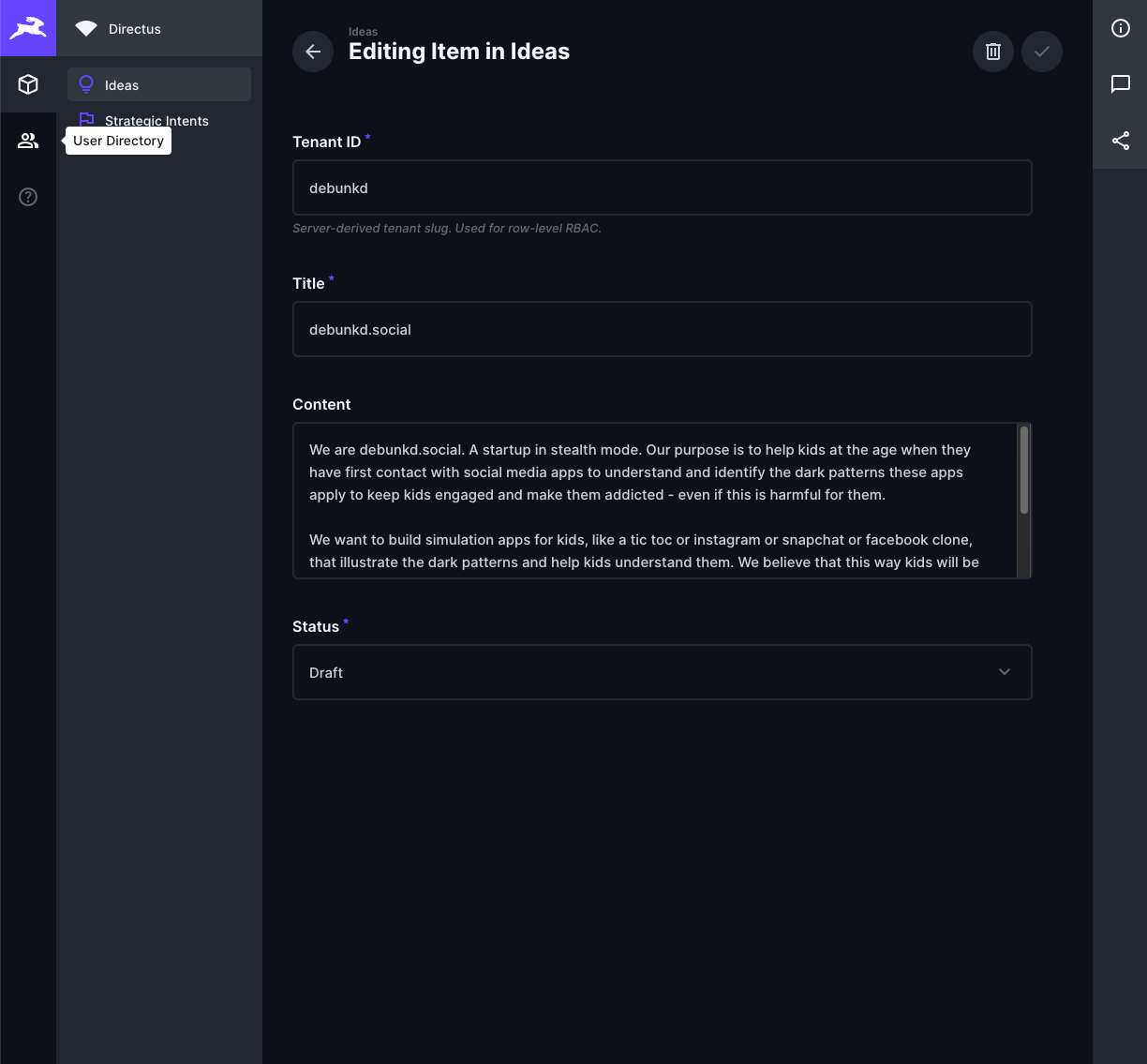
Content
A content management system where the documents, briefs, and references the firm reasons over live — readable by humans, browsable by agents, versioned over time.
Content is where firmd keeps the artefacts a mission needs to be grounded: product specs, market briefs, customer research, regulatory references, prior decisions. Each item has a schema, a URL, and a version.
The pane is an off-the-shelf headless CMS (Directus today; any CMS exposing a schema-discoverable API could plug in). Operators edit through a familiar web UI. Agents discover the same content through the CMS's schema and API.
Agents that reason only from a prompt invent plausible-sounding content. firmd refuses that mode: when a strategy mission claims something about a product feature or a market segment, the claim must trace back to a content item somebody — human or agent — can open and read.
Without a structured content pane, knowledge stays in chat transcripts and slide decks. With it, deliberation rests on a citable corpus and disputes about facts become disputes about which content item to trust.
Content is also the substrate the knowledge graph is built from. The entities, relationships, and decisions agents reason over are extracted from content items and traced back to them — making the graph an index over real material, not invented vocabulary.
The CMS exposes its data model through an API surface designed for machine discovery. Agents can list collections, read fields, and fetch records without bespoke wiring per tenant.
Edits are recorded. A mission can cite a specific version of a brief and a later audit can reproduce the exact state the agents reasoned over.
Today, content updates happen ad-hoc — whoever notices drift edits the source, and often nobody does. A specialised tech-writer participant will keep content current as the firm's deliverables grow, fold shipped increments back into the source material, and flag stale references before they reach the next mission.